

All of these auctions have closed.

Saint-Gaudens Double Eagle
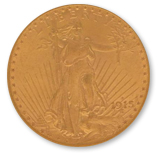
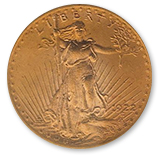
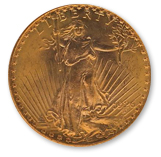
The Saint-Gaudens Double Eagle, considered by many to be the most beautiful of U.S. coins, is a twenty-dollar gold coin produced by the United States Mint from 1907 to 1933. The coin is named after its designer, the sculptor Augustus Saint-Gaudens, who designed the obverse and reverse. The coins are made from a 90% gold (0.900 fine = 21.6K) and 10% copper alloy.
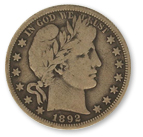
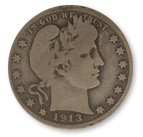
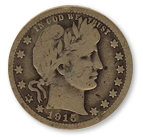
The Barber Liberty Head
Few people have had as much impact on U.S. coinage as Charles E. Barber (1840 - 1917). Replacing the Seated Liberty half dollars, the Barber or Liberty Head coins revealed only Liberty's head and neck. They are also notable for the profusion of stars-13 appear on both the obverse and reverse, a double nod to the nation's founding 13 colonies.
Standing Liberty
Succeeding the Barber quarter was the Standing Liberty quarter - featuring the goddess of Liberty on one side and an eagle in flight on the other, the coin was designed by sculptor Hermon Atkins MacNeil. It was reported that the model for the depiction of Liberty was Doris Doscher, who would later become a silent film actress under the name Doris Doree. This was accepted for many years and Doscher became well known as "the girl on the quarter."

HIGH BOOK VALUE: 1921 Standing Liberty Silver Quarter, PCGS VF-20 (Very Tough Date)
Winged Liberty
The Mercury dime is a ten-cent coin struck by the United States Mint from 1916 to 1945. Designed by Adolph Weinman and also referred to as the Winged Liberty Head dime, it gained its common name as the obverse depiction of a young Liberty, identifiable by her winged Phrygian cap, was confused with the Roman god Mercury. Weinman is believed to have used Elsie Stevens, the wife of lawyer and poet Wallace Stevens, as a model. The coin's reverse depicts a fasces, symbolizing unity and strength, and an olive branch, signifying peace.
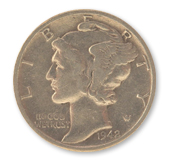
HIGH BOOK VALUE: 1942/1-D Overdate Mercury Silver Dime (Rare, Better Grade)
Braided Hair Liberty
Braided Hair obverse design, by Chief Engraver Christian Gobrecht, first appeared in 1839 as a modification to the old Matron head design. Liberty is seen in a slimmer, more youthful appearance with the braiding of the hair from ear to her forehead.
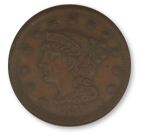
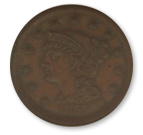
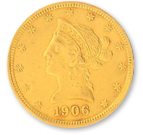
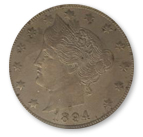
Indian Head and Liberty Head by James Barton Longacre
Designed by James Barton Longacre, the Chief Engraver at the Philadelphia Mint. The Indian Head, was said to be based on the features of Longacre's daughter Sarah; the tale runs that she was at the mint one day when she tried on the headdress of one of the Native Americans who were visiting, and her father sketched her.
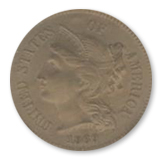
With the similar features, he designed the three-cent nickel which is used as a stopgap measure until the wartime hoarding ceased.
Capped Bust Liberty
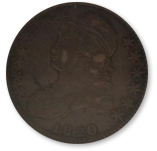
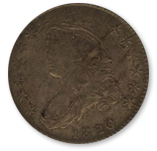
Designed by German-born John Reich. This era was one of Rubenesque beauty, as a glance at Scot's dowdy Draped Bust obverse will show - fondly called as "Reich's fat German mistress." Includes 1820/19 overdates -- the 2's in the date come with curved or straight bases, the 2's with straight bases come with or without knobs at the top.
Morgan Silver
The Morgan dollar was a United States dollar coin minted from 1878 to 1904, and then again in 1921. It was the first standard silver dollar minted since production of the previous design, the Seated Liberty dollar, ceased due to the passage of the Coinage Act of 1873, which also ended the free coining of silver. The coin is named for its designer, United States Mint Assistant Engraver George T. Morgan. The obverse depicts a profile portrait representing Liberty, while the reverse depicts an eagle with wings outstretched.

KEY DATE 1893-S Morgan
Silver Dollar
More valuable coins
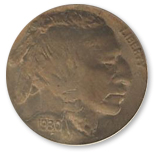
HIGH BOOK VALUE: 1930-S Buffalo Nickel, PCGS MS-65 (Scarce GEM BU, Better Date)
One of the new designs between 1907 and 1909 that was part of a drive to beautify the coinage.
One of the new designs between 1907

1872 Two Cents,
NGC VG-8BN
Civil war era coin that do not contain any nickel and are 95% made of copper.
Civil war era coin that do not contain any nickel
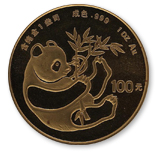
1984 1 Oz. Chinese .999 Fine Gold 100 Yuan Panda Proof
Belongs to the Panda series of gold bullion coins, featuring the Temple of Heaven in the obverse and a sitting panda eating bamboo leaves in the reverse.